
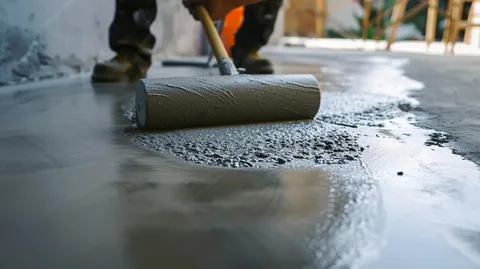
A new floor coating for the garage or basement floor gives the space a clean, long-lasting finish. But seeing that beautiful floor lift or split means that your home investment is ruined.
Figuring out the reason behind the failure of these surfaces helps avoid costly and stressful repair errors. This guide by Iron City Epoxy identifies the key concrete floor coating problems that many homeowners face.
Understanding Concrete Floor Coating Problems
When looking at concrete floor coating problems, it is necessary to determine the reason why layers are separating from the base slab. These issues will occur where the chemical bond is completely broken.
- Peeling floor coating: Large areas or sheets of solid film come off the slab.
- Cracking surface: Hairline fractures open up across the floor as a result of temperature and/or thickness changes.
- Visible bubbling: Circular blisters rise up under the surface layer.
Common causes of early coating adhesion problems.
| Type of Defect | Main Symptom | Primary Structural Cause |
| Peeling | Lifts in large sheets | Smooth surface of concrete with oil residues |
| Bubbling | Small or large blisters | Trapped moisture and rising heat |
| Cracking | Lines or brittle spots | Bad mixing ratios and thermal shifts |
The Reason Behind Peeling and Concrete Adhesion Problems
It is much easier to address the problem permanently by checking the development of a peeling floor coating. For liquid polymers, the profile must be very clean and porous, so that it securely adheres to the slab.
- Slab Contamination: Hidden engine oils, grease, and old sealers block the liquid bond in contaminated slabs.
- Smooth Surfaces: Concrete that is smooth like glass doesn’t have the rough profile necessary for grip.
- Layer of Laitance: Under heavy tires, a weak top crust, called the laitance layer, flakes off from the new concrete.
Professional teams need to use mechanical grinders to open the pores in the concrete to achieve lasting results. Without the profiling step, there will be a total failure of the concrete coating in the future
Trapped Moisture and Bubbling: What’s the Reason Behind It
Looking to address your surface problems? Blistering is caused by the most common cause: trapped water vapor.
- Moisture Vapor Pressure: Groundwater naturally rises through porous concrete slabs.
- Trapped Film: The water cannot escape into the room because of the sealed epoxy or polyaspartic layer.
- Blister Formation: The water vapor pressure increase causes the solid coating to be pushed upward.
Wet bubbles are additionally caused by outgassing. During the day, the air in the slab expands. When a floor is coated during warm-up, escaping air leaves small holes in the floor.
Why Follow Trustworthy Preparation Standards
Failure is avoided by vetting installation specialists to safely complete all required moisture tests as per industry standards. Professionals test the moisture content of the concrete within the building in question with digital relative humidity probes prior to the casting of any of their products.
Don’t proceed with your contract until you have reviewed the application plan. Good professionals will make sure that the temperature of the slab remains constant, or cools during the window of installation. They also fill in internal air pockets in concrete with a special compatible primer that seals them tightly.
Conclusion
To prevent floor defects, you need to carefully perform mechanical grinding and conduct a moisture test. Removal of surface oils provides a strong and permanent bond. Contact your local certified floor specialist for a moisture test today.
Frequently Asked Questions
1. Can I simply paint over an old garage floor that has started to peel?
No, applying the new coat over the loose material will hide the failure under the new coat. The old layer needs to be scraped off to the underlying concrete.
2. What should be the minimum curing period of a new concrete slab before it is coated?
Standard concrete formulas have a minimum of 28 days of drying and curing time. If a new slab is too early to be coated, it will retain too much moisture.
3. What is diamond grinding, and why is it important?
Diamond grinding involves the use of a heavy industrial machine fitted with a diamond-tipped blade that is used to scratch the concrete. This forms a texture similar to ‘sandpaper’ to allow the coating to ‘stick.’
4. Why are bubbles present in the wet epoxy?
This is known as outgassing. Rising temperatures of the air or exothermic heat of concrete mixing cause air pockets to swell within the concrete.
5. How can coating cracks be caused by improper chemical mixing?
Failure to use the correct ratio of parts or if too hot, the coating sets too fast. This will make the finished floor lack flexibility and be prone to splitting.